

A credit memo is where the work of credit analysis becomes visible. It brings together the borrower's financial position, business profile, key risks, relevant industry developments and the analyst's assessment in a form that can be reviewed and used in a credit decision.
But the memo is not the analysis. It is the visible product of a much larger analytical process.
Before a credit assessment reaches its final form, information has to be located across documents and sources, extracted, structured, understood, reconciled and placed within the institution's analytical framework. The analyst also has to bring together developments that sit outside the financial statements and establish their relevance to the borrower.
Most of that work never appears in the final document.
That does not make it administrative work. It is the infrastructure of the analysis.
The Work Behind the Memo
A credit assessment rarely begins with a neatly assembled set of information. Financial statements contain one part of the picture. Notes to accounts provide further detail, while operational information, management commentary and company announcements add context. Industry developments provide the external environment, and publicly available information and recent news can add a current dimension to the assessment.
The analyst brings these different sources together, but that process involves considerably more than locating numbers. A financial figure has to be understood in the context in which it appears. A disclosure has to be considered alongside related financial information. Historical information has to be brought into a consistent analytical view. Developments outside the financial statements have to be considered alongside what the financials show.
The analyst is building something that does not exist in any single source.
Financial statements, disclosures, management commentary, announcements, industry developments and public information become meaningful when they are brought together into a coherent analytical picture.

The analyst is therefore building something that does not exist in any single source: a coherent view of the borrower.
The credit memo is where that view is eventually expressed. The work required to construct it largely remains invisible.
Financial Information Is Only One Layer
Financial analysis forms the foundation of a credit assessment, but the borrower does not exist only inside its financial statements.
A company's financial position can change between reporting periods. A major acquisition can alter leverage and business risk. A change in management can affect execution or governance. A regulatory development can alter the operating environment. A significant customer event can affect business stability. A change in industry conditions can alter the interpretation of financial performance. A material announcement can change what the institution knows about the borrower since the previous assessment.
These developments do not necessarily appear in the same documents as the financial information. They have to be brought into the assessment and considered alongside what the financials show.
This is part of the work that precedes the final credit memo.
From Separate Pieces to an Analytical Picture
Consider a borrower whose cash generation has weakened while it has undertaken a significant expansion financed through additional debt, at a time when demand in the relevant industry has also weakened.
Each development is important in its own right. Together, however, they create a different analytical picture from any one of them viewed in isolation.
“The question is not simply whether cash generation has declined or leverage has increased. It is what the combination tells the institution about the borrower's financial resilience, business position and ability to meet its obligations.
That connection between separate pieces of information is central to credit analysis. The final memo might express the resulting conclusion in a few paragraphs, but establishing that conclusion requires a much broader body of work.
The Final Document Is Deliberately Selective
A credit memo cannot contain everything the analyst reviewed. It does not reproduce every source document, record every search or include every piece of information that was considered and rejected. Nor does it show every intermediate calculation or analytical step.
A credit committee needs a clear assessment, not a record of the analyst's entire working process.
The final document therefore compresses a much larger body of work. That compression can make the underlying process appear simpler than it actually is. A concise assessment can represent extensive work in locating information, understanding it, validating it, connecting it with other evidence and preparing it within the institution's credit framework.
The work disappears from the memo because the memo is designed to present the conclusion, not the entire process that produced it.
Invisible Does Not Mean Administrative
Work that does not appear in the final credit memo is not automatically clerical work.
Preparing information for analysis can require knowledge of the institution's methodology. Interpreting a disclosure can require analytical understanding. Reconciling apparently different pieces of information can require judgment. Determining whether an external development has relevance to the borrower requires an understanding of the business and its risks.
The fact that the final memo contains only the resulting conclusion does not diminish the analytical significance of the work that preceded it. It means that the institution's analytical process contains a substantial layer of work that sits between source information and credit judgment.
That layer is easy to overlook precisely because the final credit memo hides it.
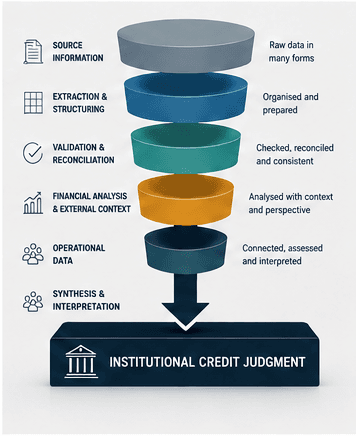
The Analytical Infrastructure
This is where the discussion about intelligent credit platform becomes more meaningful.
The purpose of intelligent credit platform is not to make the institution's credit judgment automatic. Its purpose is to strengthen the infrastructure through which the institution arrives at that judgment.
That infrastructure begins with source information and extends through extraction, structuring, validation, financial analysis, external information, contextual enrichment and synthesis. It ultimately brings the relevant evidence into a form that supports the institution's established credit process.
The institution retains its own policies, methodologies, analytical frameworks and decision standards. Technology works within those requirements rather than imposing a different way of assessing credit.
The value therefore does not come from replacing the institution's approach. It comes from making the information and analytical processes around that approach more capable, connected and structured.
Strengthening What Sits Behind the Decision
The credit memo is the visible expression of the institution's credit assessment. Behind it sits an information and analytical infrastructure that determines the quality, completeness and usability of the evidence available to the analyst.
Strengthening that infrastructure has a direct purpose: bringing relevant information together, creating structure around information that arrives in different forms, connecting financial information with relevant external developments and supporting the institution's analytical framework.
The objective is not to make the memo longer or to replace institutional judgment. It is to strengthen the work that happens before the judgment is recorded.
The Opportunity for Intelligent Credit Platform
Credit institutions have already invested in methodologies, policies, models and experienced professionals. The analytical infrastructure surrounding those assets deserves the same level of attention.
When information remains fragmented across documents, sources and workflows, professional expertise is spent assembling the foundation on which analysis depends. When that infrastructure is strengthened, the institution has a more coherent basis for applying its existing methodology and professional judgment.
This is the real opportunity for intelligent credit platform: to strengthen the analytical infrastructure that connects information to institutional judgment.
The institution's credit framework remains intact. The analyst's judgment remains intact. What changes is the quality of the infrastructure supporting both.
The final credit memo will always be selective. It has to be. Most of the work behind it will therefore remain invisible.
That does not make the work peripheral to credit analysis.
It is what makes the analysis possible.