

A credit assessment draws on more than financial statements. The financials provide the quantitative foundation, but understanding a borrower requires a broader information set: business developments, industry conditions, management actions, corporate events, regulatory developments, relevant news and other information that provides context to the financial position.
The availability of this information has expanded significantly. The more important question is what happens when it comes together.
The objective is not to give the analyst more information to consume. It is to bring together the information that matters, establish the relationships between seemingly separate developments and make their implications clear enough to support a credit decision.
That is where credit judgment begins.
Information Is the Starting Point, Not the Conclusion
A financial number provides a fact. An external development provides another fact. Neither, by itself, necessarily establishes what it means for the borrower's credit profile.
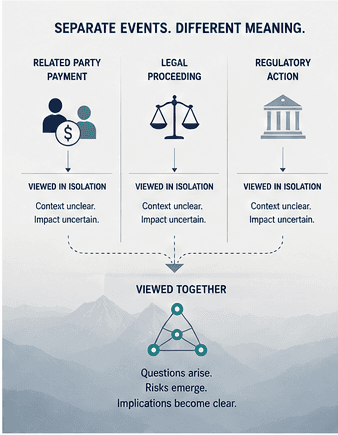
Consider a borrower whose financial statements show stable revenue, healthy operating margins and adequate liquidity. A review beyond the financial statements identifies a large payment to a related party, a legal proceeding involving that party and a subsequent regulatory action affecting one of the borrower's key licences.
None of these developments, viewed in isolation, necessarily changes the credit view. Taken together, however, they create questions around the nature of the related-party transaction, potential contingent liabilities, governance and the sustainability of part of the borrower's operations.
The financial statements have not changed materially. The credit picture has.
This is the difference between information being available and information becoming analytically useful. The analyst has to determine how individual developments relate to one another, whether they are material to the borrower and what they imply for the credit assessment.
Separate Events, Different Meaning
Individual developments may appear limited when viewed in isolation. Their significance can change when the relationships between them become visible.
A 360° View Must Create Context
A 360° view of a borrower is therefore not simply a broader collection of information. Its value lies in bringing together different dimensions of the borrower so that relationships and implications become visible.
Financial performance may show one part of the picture. Corporate developments, related-party transactions, regulatory actions, litigation, management changes, industry conditions and current public information can reveal other parts.
Consider an increase in leverage. The number itself is clear, but the analytical question begins with understanding what drove it. Debt raised to finance an acquisition creates one set of considerations. Debt raised for capital expenditure creates another. Debt raised to support a weaker group company or associate creates an entirely different set of questions around the use of funds, financial support obligations and potential contagion from the related entity.
The analyst then has to assess the implications in the context of the wider borrower relationship. Is the funding temporary or recurring? Is the related entity strategically important to the borrower? Does the borrower have an explicit or implicit obligation to continue providing support? What does the related entity's financial position indicate about the potential demands on the borrower?
The leverage number is the same. The credit question changes when the information surrounding it comes together.
That is the purpose of a 360° view: not to surface everything that can be found about a borrower, but to identify and connect the information that changes the understanding of its credit position.
From Information to Implications
Bringing information together is only the beginning. The analytical value emerges when the relevant information is structured, related and assessed in context.
A financial figure may need to be considered alongside the transaction or event that produced it. A corporate development may need to be examined against the borrower's financial capacity. An external event may acquire significance only when viewed alongside an existing exposure or vulnerability.
This is where separate facts begin to form an analytical picture.
Once the relevant relationships have been established, the analyst has to determine what they mean.
What has changed? Why has it changed? How significant is it? Which developments are connected? What risks arise from them? What mitigants exist? What does the combined evidence indicate about the borrower's financial and business resilience?
These questions require more than the presentation of facts. They require interpretation.
A decision-oriented assessment therefore needs to distinguish between developments that provide context and those that have implications for the credit view. It needs to establish which issues warrant attention, connect the relevant evidence and make the resulting implications clear.
The purpose is not to create another layer between information and judgment. It is to reduce the distance between them.
The Report Must Lead to a Credit Decision
A credit report exists to support a decision. It therefore has to do more than describe the borrower or present a comprehensive collection of observations.
A report that identifies a related-party payment, a legal proceeding and a regulatory action, but presents them as unrelated facts, leaves the reader to establish their significance. A report that connects those developments and explains why they matter creates a basis for assessing the associated credit risks.
The same principle applies to financial information. An increase in leverage is not, by itself, a credit conclusion. Its significance depends on why the borrowing occurred, how the funds are being used, the financial position of the entities involved and the borrower's ability and willingness to support them.
The report therefore needs to establish what has changed, why it matters, what risks arise from those changes, what mitigants exist and what the overall evidence indicates about the credit profile.
The purpose of the report is not to make the credit file larger. It is to make the credit assessment clearer.
The Analyst's Value Lies in Interpretation
This is where professional credit judgment becomes important.
The analyst has to challenge the evidence, assess competing explanations, determine materiality, understand the relationships between developments and decide what they mean within the institution's established credit framework.
The objective of a broader information set is not to remove this work. It is to make this work more focused.
An analyst should not have to spend disproportionate time determining which of dozens of developments matter, locating supporting information across multiple sources or reconstructing relationships between facts that have already been identified.
The value lies in bringing the relevant evidence together so that the analyst can spend more time asking the questions that actually require judgment:
What is the central risk? What has changed? What supports the existing credit view? What challenges it? What remains unresolved?
The output should therefore lead the analyst toward a credit view rather than leave the analyst with another information set to process.
The Role of the Analytical Platform
An intelligent credit platform has an important role across this process, but that role is specific.
It can bring together financial and non-financial information, identify relevant developments, connect information across sources, organize it within the institution's established framework and generate analytical outputs and credit memos in the formats required by the institution.
The platform works within the institution's own policies, methodologies, models and decision standards. Its role is to bring together relevant evidence, establish context, connect related information and present the resulting analysis in a form that supports the institution's established credit process.
The analyst evaluates that evidence within the institution's framework, applies professional judgment and forms the credit view. The institution retains responsibility for the resulting credit decision.
Decision-Ready Intelligence
Decision-ready intelligence is therefore not simply a larger information set.
It is information that has been brought together, contextualised and synthesized sufficiently for the analyst to assess its significance within the institution's established framework.
A decision-ready analytical output makes material changes visible, connects related evidence, distinguishes significant developments from background information and presents the implications clearly enough for the analyst to challenge, validate or refine the credit view.
This distinction becomes increasingly important as the information available to credit teams continues to expand. The ability to process more information is valuable only when it improves understanding. Otherwise, the burden simply moves from information gathering to information consumption.
The objective is not to produce a report that says more.
It is to produce a report that makes the credit picture clearer.
From Information to Credit Judgment
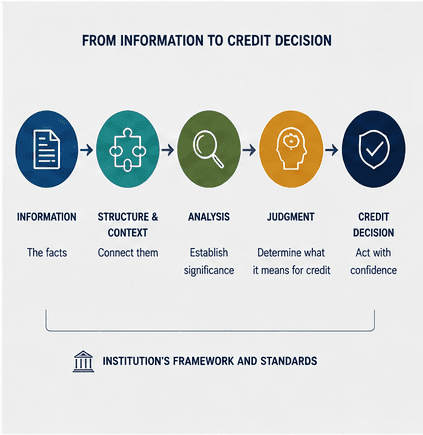
The progression is straightforward: information provides the facts; structure and context connect them; analysis establishes their significance; judgment determines what they mean for credit; and the credit decision follows from that judgment.
An intelligent credit platform can strengthen this process by bringing together the relevant evidence, connecting information across sources and presenting it within the institution's established analytical framework.
The measure of its value is therefore not the number of documents processed, data points extracted or pages generated. It is whether the platform enables the analyst to see the borrower's credit position more clearly and arrive at a well-reasoned, defensible credit view.
The purpose of an intelligent credit platform is to ensure that, when the relevant information comes together, the analyst is looking at a coherent credit picture—not another pile of information.
When the Right Information Comes Together, Credit Judgment Begins.